- Productization means packaging services with fixed scope, pricing, and deliverables you can sell repeatedly.
- A common example is a design agency offering three logo packages at set prices instead of quoting each project individually.
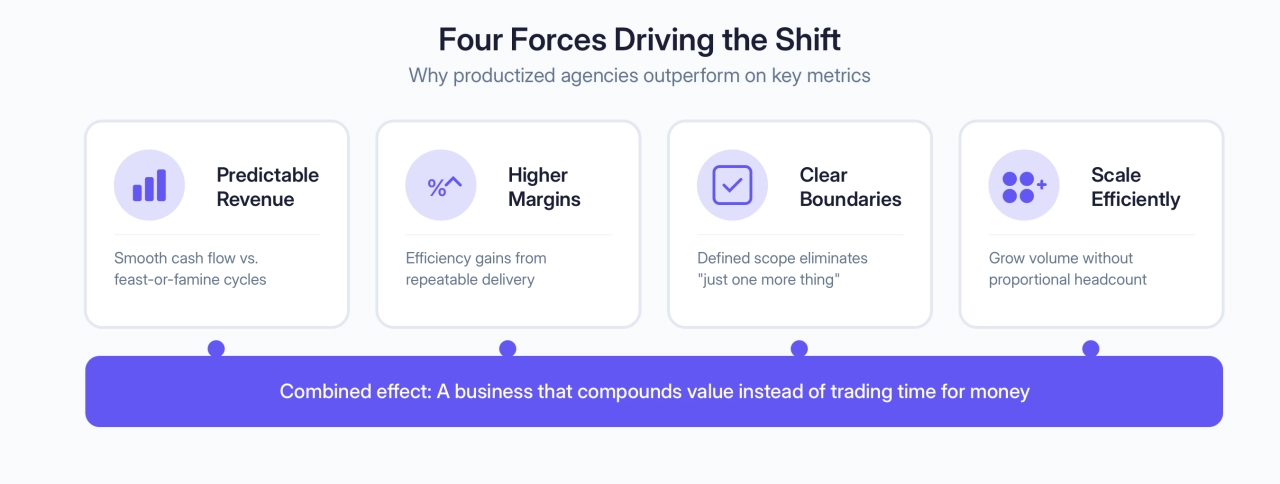
- The shift creates predictable revenue, higher margins, and a business that can scale without you personally involved in every project.
How often have you finished a custom project, sent the final invoice, and immediately wondered where your next paycheck would come from?
That cycle of feast-or-famine revenue is one of the biggest reasons agency owners burn out. You’re constantly selling, constantly scoping, constantly reinventing the wheel for each new client. And the moment you stop hustling, the pipeline dries up.
Productization offers a way out.
According to the 2024 Marketing Agency Benchmarks Report from AgencyAnalytics (based on a survey of 251 agency leaders), 43% of agencies now use monthly or annual retainers as their primary pricing model. That shift toward predictable, packaged offerings didn’t happen by accident. These agencies restructured how they sell and deliver services to create income streams that don’t depend on landing the next big project.
This post breaks down what productization actually means, why it works, and how to determine whether it’s the right move for your agency. The focus here is on the concept itself and the business case behind it—not step-by-step implementation tactics, which I cover in a separate guide.
Understanding this topic involves several interconnected concepts:
Each of these concepts plays a crucial role in the overall topic.
What is productization?
Productization is the process of transforming custom, one-off services into standardized offerings with fixed scope, pricing, and deliverables. Instead of scoping every project from scratch and negotiating terms each time, you define exactly what’s included, what it costs, and how long it takes—then sell that package repeatedly.
Think of it as the difference between a restaurant with no menu (where the chef asks what you feel like eating and quotes a price) versus one with a fixed menu and set prices. Both can serve excellent food. But only one can scale without the owner personally handling every order.
For agencies, this means moving away from proposals that start with “it depends” and toward offerings that clients can understand, compare, and purchase without lengthy discovery calls.
Productization vs. a productized service
These terms get used interchangeably, but there’s a useful distinction:
Productization is the process—the work of analyzing your services, standardizing delivery, setting fixed prices, and building systems that let you sell consistently.
A productized service is the result—the actual packaged offering you sell to clients. It has defined deliverables, a clear timeline, and a set price.
An agency might go through productization once but end up with multiple productized services: a monthly SEO retainer, a one-time website audit, a quarterly content package. The process creates the offerings.
The mindset shift matters more than the terminology. Traditional service businesses ask “what do you need?” and then figure out how to deliver it. Productized businesses ask “here’s what we deliver—does this solve your problem?” That flip affects how you sell, who you hire, and how you spend your time as an owner.
The productization spectrum
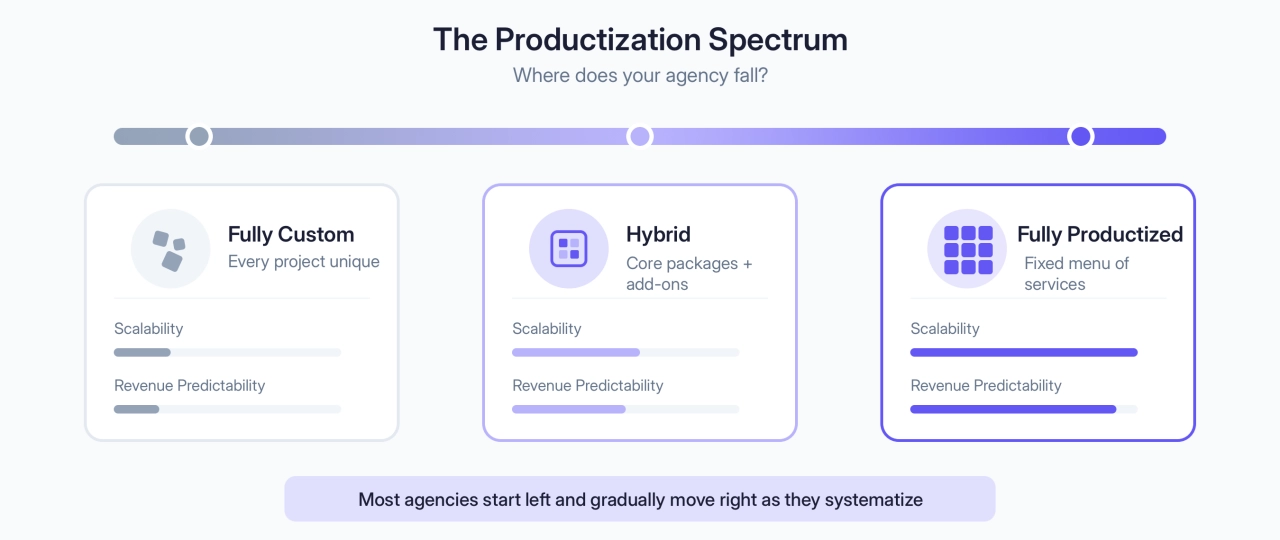
Most agencies don’t operate at the extremes. They’re not running a fully custom consultancy where every engagement is bespoke, and they’re not selling identical packages to every client like a SaaS product. They’re somewhere in between.
Understanding where you fall on this spectrum helps clarify what productization would actually look like for your business:
Approach | How it works | Pricing | Scalability |
|---|---|---|---|
Fully custom | Every project scoped individually. Deliverables, timeline, and price negotiated per client. | Hourly or custom quotes | Low—revenue tied directly to hours worked |
Hybrid | Core packages with defined deliverables, plus optional add-ons or customization layers. | Base price + extras | Medium—standardized core with flexibility |
Fully productized | Fixed offerings with set scope, price, and timeline. Clients choose from a menu. | Fixed pricing | High—systems and processes are repeatable |
A web design agency might sit in the hybrid zone: they offer three website packages (Starter, Growth, Enterprise) but allow clients to add custom integrations at an hourly rate. A content agency might be fully productized: 4 blog posts per month, 1,500 words each, $2,000/month, no exceptions.
Neither approach is inherently better. The right position depends on your services, your clients, and your goals. But here’s what the data shows: agencies that move toward the productized end of the spectrum tend to report higher margins, better client retention, and more predictable revenue.
You don’t need to productize everything overnight. Most agencies start by identifying one or two services that would benefit from more structure—and build from there.
Benefits of productizing your services
Agencies that have made the shift report measurable improvements across revenue, margins, and client relationships. Let’s look at the specifics.
Predictable revenue
Custom work creates revenue spikes and valleys. You close a big project, work intensely for two months, invoice, then scramble to fill the pipeline again. Productized services, especially recurring ones, smooth out that volatility.
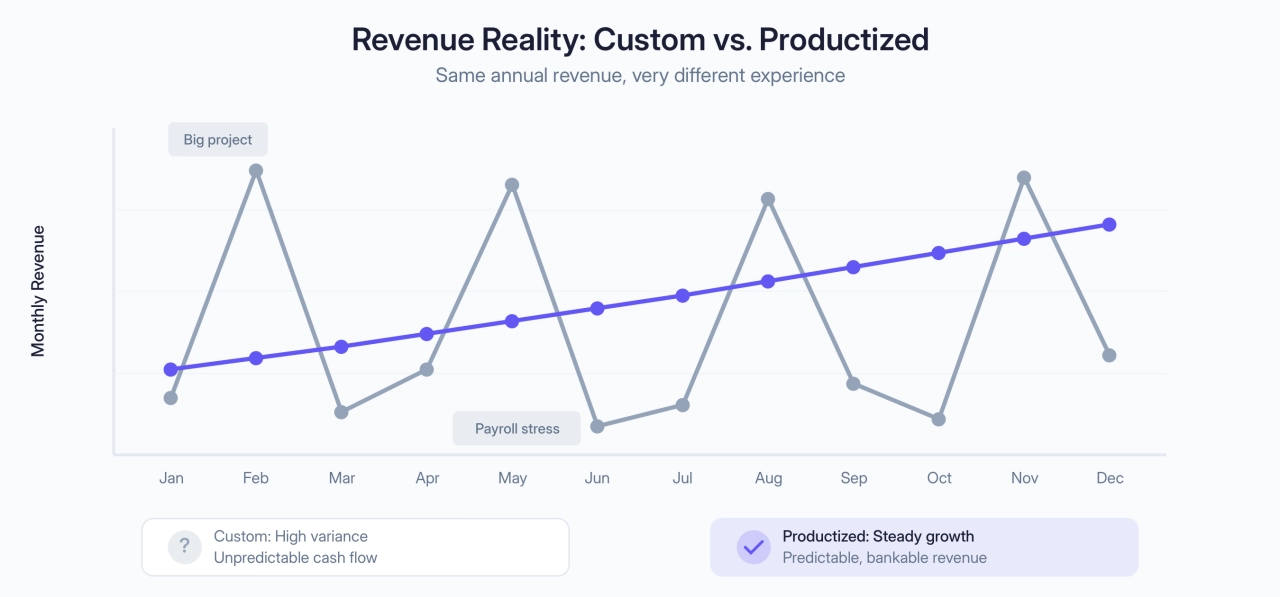
When you sell recurring packages, be it monthly retainers, quarterly engagements, annual subscriptions, revenue becomes predictable. You know what’s coming in next month before the month starts. That changes how you hire, how you invest, and how much sleep you get.
Jason Holicky, owner of Holicky Corporation, puts it simply:
Recurring revenue is the lifeblood of our company. It ensures we can make payroll without stress and invest in subscription software and other essential services. Without it, we’re constantly chasing the next project.
 Jason Holicky,
Holicky Corporation
Jason Holicky,
Holicky Corporation
And there’s a compounding benefit most agency owners overlook: if you ever want to sell your agency or bring on investors, recurring revenue dramatically increases what your business is worth. Buyers pay a premium for predictability.
Higher profit margins
The 2025 Agency Growth Benchmark from Predictable Profits analyzed over 300 agencies and found that specialized, productized agencies report gross margins between 40% and 75%. Compare that to the industry average of 18–22% for general service agencies.
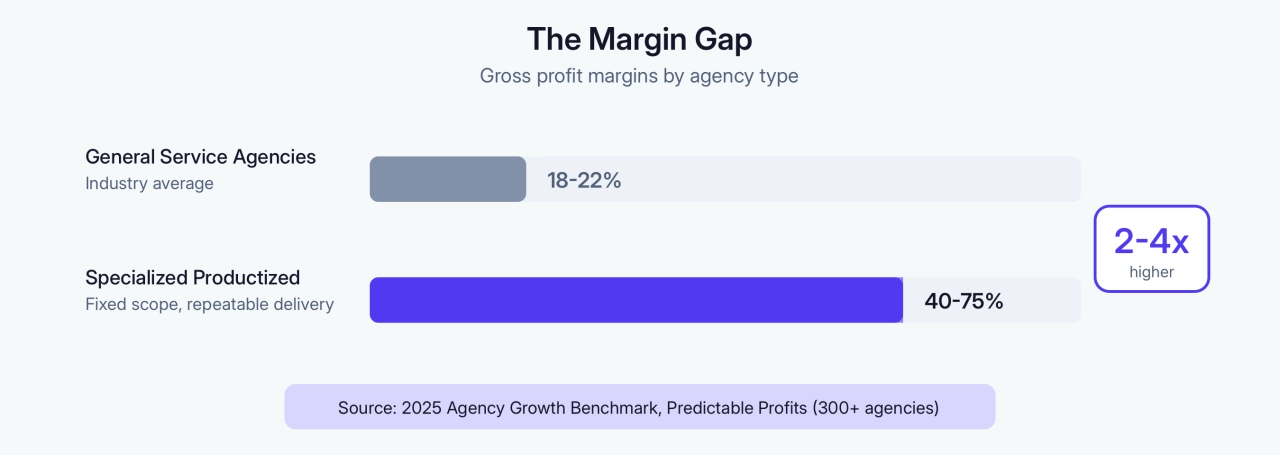
Why the difference? When you deliver the same service repeatedly, you get faster at it. You build templates, refine processes, and eliminate the learning curve that eats into margins on custom projects. Your tenth website audit takes half the time of your first one—but you charge the same price.
Reduced scope creep
Custom projects invite scope creep. When deliverables are negotiated rather than defined, clients naturally push for just one more thing. And because the relationship feels bespoke, saying no feels like bad service.
Productized services solve this by setting clear boundaries upfront. The package includes X, Y, and Z. Anything beyond that is a separate purchase. Clients understand what they’re buying because it’s the same thing you sold the last fifty clients. Your Terms of Service formalize these boundaries—defining revision limits, what’s included, and how out-of-scope requests are handled.
This clarity benefits both sides. Clients know exactly what to expect. Your team knows exactly what to deliver. Nobody ends up frustrated by mismatched expectations three weeks into a project.
Scalability without proportional costs
In a custom service business, revenue scales linearly with headcount. To make more money, you need more people doing more work. That model caps out faster than most owners want to admit.
Productization breaks that link. When you standardize delivery and build the right tech stack, you can increase volume without proportionally increasing costs. The same team that delivered ten SEO audits last month can deliver fifteen next month because they’re not reinventing the process each time. The challenge becomes maintaining quality as you scale—but that’s a solvable problem with the right systems.
Common productization myths
I hear the same objections come up in conversations with agency owners. Some have merit, most don’t. Let’s address them directly.
“Productized services are low-value commodity work”
This assumes standardization means racing to the bottom on price. The data says otherwise.
Specialized agencies that productize report margins well above the industry average. Standardization lets you get very good at one thing. Clients pay premium prices for expertise and reliability, not for custom scoping.
Daniel Meursing, founder of Event Staff, found that clarity actually attracted higher-value clients:
A meaningful shift came when we rebuilt our positioning around the exact outcomes our clients were trying to buy instead of the services we offered. That one change pulled in higher-value accounts almost immediately.
 Daniel Meursing,
Event Staff
Daniel Meursing,
Event Staff
“Clients want customization—they won’t buy packages”
Some clients do want fully custom work. They’re not your target market.
Plenty of buyers prefer knowing exactly what they’ll get, what it will cost, and when it will be delivered. That clarity signals you’ve solved this problem before and know what works.
The agencies that struggle with this myth are often trying to productize without narrowing their audience. When you serve everyone, packages feel restrictive. When you serve a specific market with a specific problem, packages feel like exactly what they need.
“You can’t productize complex or strategic services”
This one has some truth to it—but less than you’d think.
Yes, a full-scale digital transformation for an enterprise client probably can’t be packaged into a fixed-price offering. But most “complex” services have repeatable elements buried inside them.
A brand strategy engagement might be custom at the top level, but the research phase, the workshop facilitation, and the deliverable formats can all be standardized. Many agencies productize the components even if the overall engagement stays flexible.
Is productization right for your agency?
Productization works well for many agencies, but not all. The model fits best when you’re delivering similar work repeatedly, can define clear deliverables, and have a target market large enough to sell the same package to.
If every project is genuinely unique, or your value comes from deep customization and personal involvement, a custom model may serve you better. Many successful agencies keep a custom tier for enterprise clients while productizing their core offerings for the mid-market—you don’t need to pick one model exclusively.
For a deeper assessment, I built a 2-minute suitability quiz that evaluates your service across process, market, and scalability factors. It’ll show you exactly where you stand and what gaps to address first.
And if you’re ready to move forward but want to understand what can go wrong, here are eight risks every agency owner should plan for.
Frequently asked questions
What’s the difference between productized services and SaaS?
SaaS provides software that clients use themselves. Productized services deliver done-for-you work performed by people. A client might pay $99/month for SEO software (SaaS) or $2,000/month for an SEO agency to handle it (productized service). Some agencies blend both models by offering proprietary tools alongside their services.
How long does it take to productize a service?
Packaging and launching a productized offering can take a few weeks if you already have informal processes in place. Building systems to deliver consistently at scale typically takes three to six months. Transitioning existing clients may take longer.
Can I productize a high-touch or relationship-driven service?
Yes, but be selective about what you standardize. The delivery process, reporting format, and communication cadence can all be systematized without removing the human element. The key is identifying which parts clients value as “high-touch” versus which parts they just need done well.
How should I price my productized services?
Price based on value delivered, not time spent. As you get more efficient, your effective hourly rate increases even if client pricing stays the same. Most agencies start by calculating costs and desired margin, then validate against market rates. For inspiration, see how other agencies price their packages.
Making the shift
You don’t need to overhaul everything at once. Start with one service you’ve delivered successfully multiple times—define the scope, set a price, document the process. The agencies seeing the best results followed that same path: specific market, packaged services, repeatable systems.
Productization compounds over time. Your first package will be rough. Your tenth will be dialed in. And somewhere along the way, you’ll realize you’re running a business that generates revenue whether or not you’re personally involved in every project.
If you’re ready for implementation details, the full guide to productizing a service covers the tactical steps.