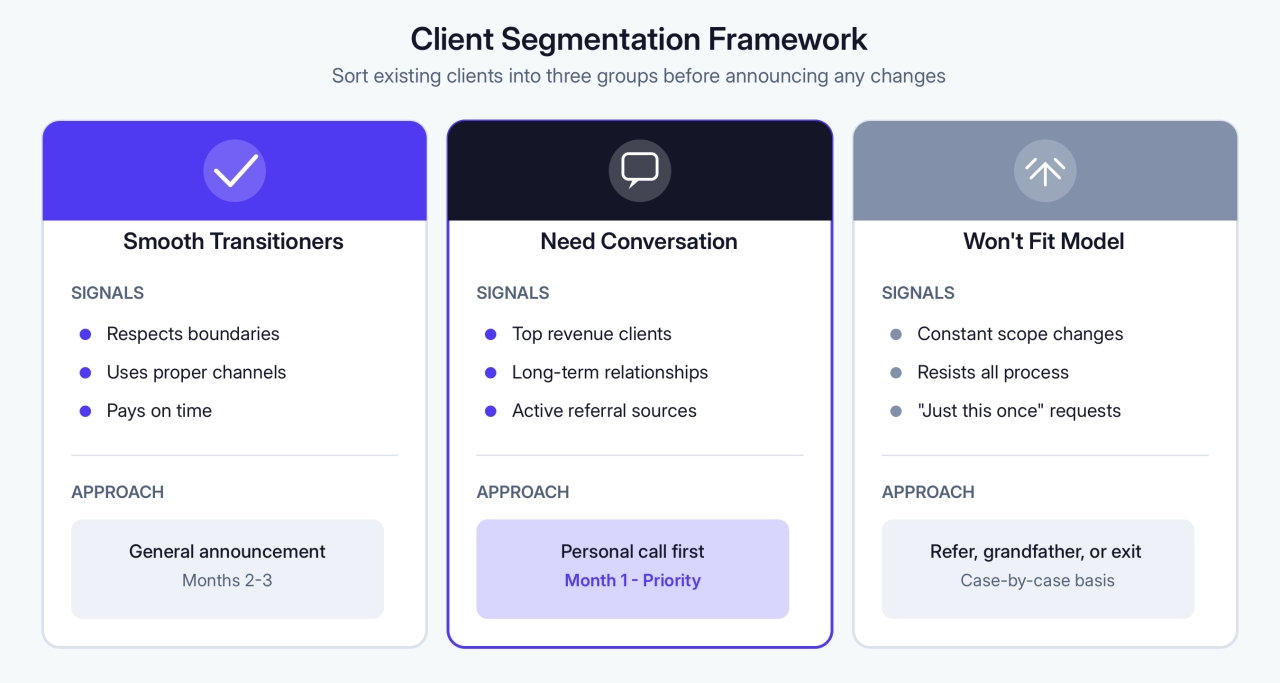
- Segment clients into three groups before announcing anything—those who'll transition smoothly, those who need a personal conversation, and those who won't fit the new model.
- Use a 6-month timeline: private outreach to top clients in Month 1, broader announcement in Months 2-3, transition support through Month 5, then fully productized.
- Build intentional flexibility into your tiers so customization has a price—clients who need it can pay for it, which naturally reduces how much they ask for.
You’ve decided to productize your services. But what do you do with existing clients—the ones who’ve been with you for years, send requests via email at 11pm, and have never logged into a client portal?
Most productization advice assumes you’re starting fresh. If you’re running an established agency with real relationships, you need a transition strategy that doesn’t blow up your business in the process.
This guide covers how to migrate existing clients to a productized model—when to transition them, when to grandfather them, and when to part ways entirely.
Understanding this topic involves several interconnected concepts:
Each of these concepts plays a crucial role in the overall topic.
Why client transitions fail
The instinct is to announce your new productized model and expect clients to adapt. After all, you’re making things better—clearer deliverables, faster turnaround, a proper system instead of chaos. Why wouldn’t they want that?
Here’s the problem: your clients didn’t sign up for a system. They signed up for you.
That custom arrangement you’ve been running? The one where they email whenever, ask for quick favors, and you figure out the scope as you go? From their perspective, that flexibility is the service. A productized service removes that flexibility by design.
When you productize, you’re asking them to give up flexibility they value—even if that flexibility was costing both of you. Handle it poorly, and you don’t just lose a client; you lose the referrals they would have sent, the case study they could have become, and your own confidence in the model.
The goal isn’t to transition every single client, but to transition the right clients well, and handle the rest with enough care that you preserve the relationship even if the engagement ends.
Segment your clients before you do anything else
Not all clients should be treated the same during a transition. Some will adapt easily. Others will resist no matter what you do. And a few are fundamentally incompatible with a productized model.
Before you announce anything, sort your clients into three groups.
Clients who will transition smoothly
These are the clients who already respect boundaries. They submit requests through proper channels, understand scope, and pay on time. They might even be relieved when you introduce a clearer system.
These clients get the general announcement in Months 2-3 (as outlined in the timeline below), not the personal call. They don’t need special handling—just clear information about what’s changing and when.
Clients who need a conversation
Your top revenue clients. The ones who’ve been with you for years. The ones who refer you business.
Kate Derkach, PR Manager at Alty, puts it well:
We prefer to discuss rate changes over a call to gauge reactions and address any objections directly. Such news is always better conveyed in person rather than through a cold email.
 Kate Derkach,
Alty
Kate Derkach,
Alty
For these clients, the approach is different:
personal outreach before any public announcement
frame the change as an evolution, not a policy
offer flexibility: grandfathered rates, extended timelines, or a premium tier that preserves some customization
give them 3-6 months to adjust, not 30 days
Part of the transition includes getting clients onto your new terms—see our legal framework for productized services for what those terms should cover.
In the end, the extra effort pays off. These clients often become your biggest advocates for the new model once they see it working.
Clients who won’t fit the new model
Some clients chose you specifically because you’d do whatever they asked. The productized model removes the thing they valued most.
Be honest with yourself about who these are. Signs include:
constant scope changes and “just this once” requests
resistance to any process or system you’ve introduced
expectations that don’t match what you’re building
For these clients, you have three options: refer them to a partner who does custom work, grandfather their current arrangement until a natural end point, or have an honest conversation about parting ways.
James Shaffer, Managing Director at Insurance Panda, learned this the hard way:
I wanted to overdeliver, so I stretched my scope, responded to clients at all hours, and let ‘small favors’ pile up. It always backfired. Clients got used to unlimited access, projects ballooned beyond control, and I ended up overworked and underpaid.
 James Shaffer,
Insurance Panda
James Shaffer,
Insurance Panda
Letting go of incompatible clients feels scary. But keeping them undermines everything you’re trying to build.
The 6-month transition timeline
Rushing a transition is the fastest way to lose clients you could have kept. Give people time to adjust, and most will.
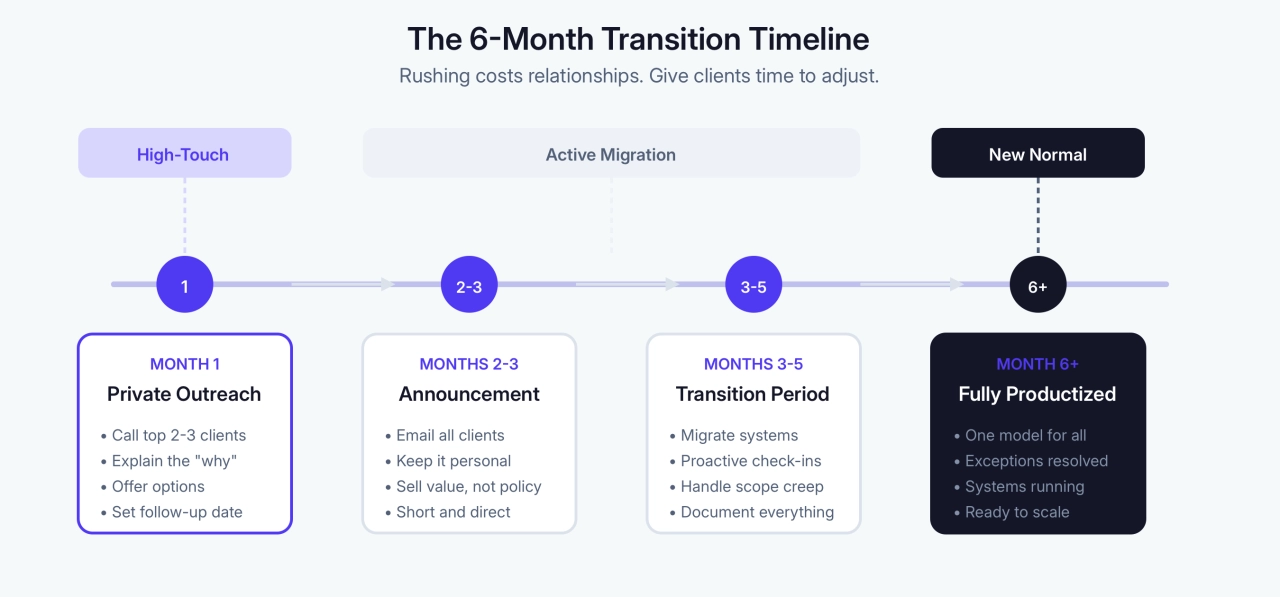
Here’s a timeline that works.
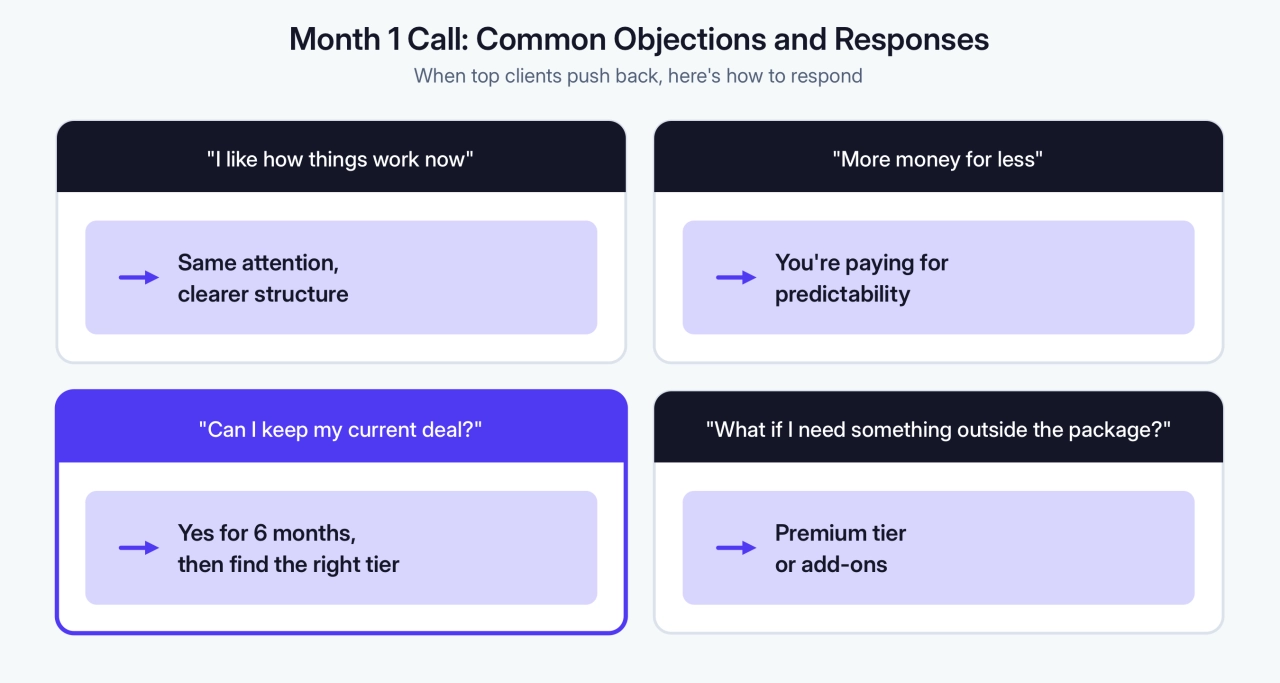
Month 1: Private outreach to key clients
Start with your top two or three clients by revenue. Call them. Not email—call. Explain that you’re evolving your service model, what that means for them specifically, and that you wanted them to hear it from you first.
You’re not negotiating. You’re informing them of a direction you’ve already decided on. But you’re also showing respect by giving them early notice and a chance to ask questions.
During these calls:
explain the why (better service, more predictable delivery, clearer scope)
outline what stays the same and what changes
offer options if they have concerns (extended timeline, premium tier, grandfathered rates)
set a follow-up date to check in
Months 2–3: Broader announcement
Once your key clients are informed, roll out the announcement to everyone else. Email works fine here, but make it personal—not a mass blast that feels like a policy memo.
Your announcement should cover:
what’s changing and when it takes effect
why this benefits them (not just you)
what they need to do, if anything
who to contact with questions
Keep it short. Long explanations sound like justifications.
Months 3–5: Transition period with support
This is where the real work happens. You’re migrating clients to new systems, new packages, new ways of working together. Expect friction.
During this period:
check in proactively with clients who seem hesitant
document everything—what’s included, what’s not, what happens if they need something outside scope
be flexible on timing, firm on the destination
handle scope creep immediately (more on this below)
Month 6+: Fully productized
By now, most clients should be operating within your new model. The ones who couldn’t adapt have either upgraded to a premium tier, been referred elsewhere, or left.
From here, you’re running a productized business. New clients come in through your standard packages. Existing clients operate within the same system. The exceptions are gone or contained.
The 6-month window isn’t arbitrary. It’s long enough for clients to plan and adjust, but short enough that you’re not running two business models indefinitely.
From here, the 3-pillar scaling framework shows how to grow without becoming the bottleneck again.
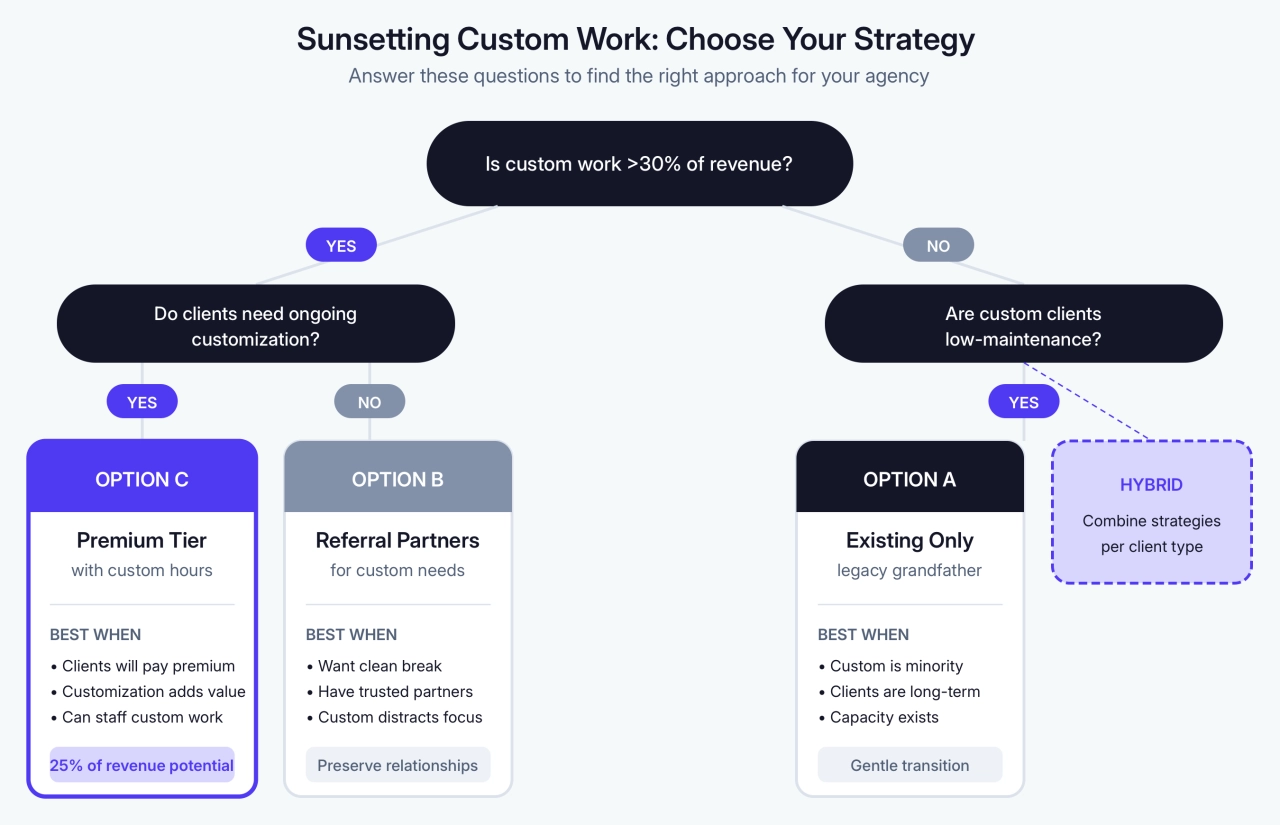
3 strategies for sunsetting custom work
The hardest question in any transition: what do you do with the custom work that doesn’t fit your packages?
You have three options. The right choice depends on your business, your clients, and how much custom work you’re currently doing.
Option A: Existing clients only
Keep doing custom work for current clients, but stop accepting it from new ones.
This is the gentlest approach. Your legacy clients get to keep what they have. You honor the relationship. And over time, as those clients naturally churn or evolve, the custom work shrinks on its own.
The downside: you’re running two business models simultaneously. That’s manageable if custom work is a small percentage of revenue, but exhausting if it’s the majority.
Best for agencies where:
custom clients represent a minority of revenue
those clients are long-term and low-maintenance
you have capacity to serve both models without burning out your team
Option B: Referral partnerships
Stop doing custom work entirely, but don’t abandon the clients who need it. Instead, refer them to trusted partners who specialize in bespoke services.
This approach is cleaner. You’re not maintaining two models. And if you choose your partners well, you preserve the relationship—clients still see you as someone who helped them, even if the help was connecting them to someone else.
Build your referral network before you need it:
identify 2–3 agencies or freelancers who do excellent custom work
have conversations with them about referrals (ideally reciprocal)
introduce them to clients personally, not through a generic “we no longer offer this” email
Best for agencies where:
custom work is a significant distraction from your core offering
you have relationships with other providers who can serve those clients well
you want a clean break without damaging relationships
Option C: Premium tier with customization budget
Build customization into your productized model through a premium tier that includes a set number of custom hours or requests per month.
This is the most flexible approach. Clients who need customization can get it—they just pay for it. And by putting a price on custom work, you naturally reduce how much of it people ask for.
Chris Percival, Founder of CJPI, saw this work:
The mid-tier became the most popular, with over 60% of clients opting for it, while the premium tier attracted high-value customers, who accounted for 25% of revenue in just six months.
 Chris Percival,
CJPI
Chris Percival,
CJPI
Structure it clearly:
premium tier includes X hours of custom work per month
additional custom work billed at a defined hourly rate
custom requests go through a formal process, not casual emails
Best for agencies where:
some customization genuinely improves outcomes
you have clients willing to pay premium rates
you can staff custom work without disrupting standard delivery
Choosing the right strategy
Most agencies combine all three—pick the right approach for each client. The key is deciding before you announce anything. If a client asks “what happens to my custom work?” you need an answer ready.
Building the right amount of customization
Productized doesn’t mean rigid. The best productized services include intentional flexibility—enough to serve different client needs, not so much that you’re back to doing custom work.
Nicholas Robb of Design Hero puts it well:
Success lies not in giving customers more options but in designing choices that subtly guide them to the right one. Too much freedom overwhelms people.
 Nicholas Robb,
Design Hero
Nicholas Robb,
Design Hero
Where customization adds value
Some customization actually improves your service. The trick is identifying which kinds.
Customization | Works? | Why |
|---|---|---|
Intake and onboarding | Yes | Different starting points, better delivery without changing core process |
Communication preferences | Yes | Weekly calls vs async updates costs you little, builds loyalty |
Add-on services | Yes | Extra deliverables at a premium—structured upsell |
Timing flexibility | Yes | Rush fees and extended timelines are easy to accommodate |
Scope changes mid-project | No | That's scope creep—handle with change orders, not flexibility |
Unique deliverables | No | Creating from scratch = custom work. Premium tier or refer out |
Process exceptions | No | "Send it differently" compounds into 15 workflows |
For help defining what belongs in each tier, the full productization guide walks through packaging and pricing.
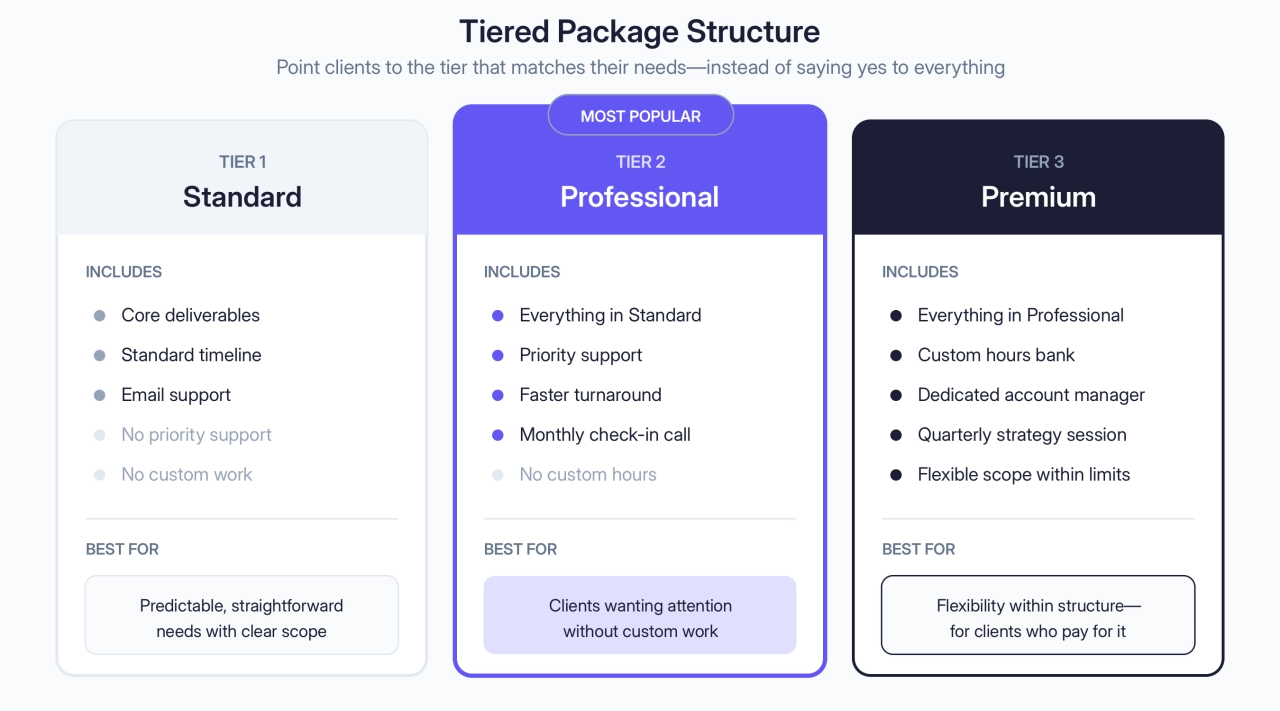
Tiered packages that absorb variation
The cleanest way to handle customization is through tiers. Instead of saying yes to every request, you point to the tier that includes what they need.
A simple structure:
If you’re unsure how to structure your tiers, these productized service examples show real pricing from 13 agencies.
The middle tier usually becomes your anchor. Most clients choose it because it feels like the right balance of value and investment. For more on structuring tiers effectively, see our productized business model tips.
Managing scope creep during transition
The transition period is when scope creep hits hardest. Clients test boundaries, partly to see what they can get away with, partly because they’re genuinely unclear on the new rules.
When a client asks for something outside scope:
acknowledge the request without committing
reference the agreed scope: “That’s outside what we’ve outlined for this tier”
offer a path forward “I can add that as a one-time add-on for $X”
document everything in writing
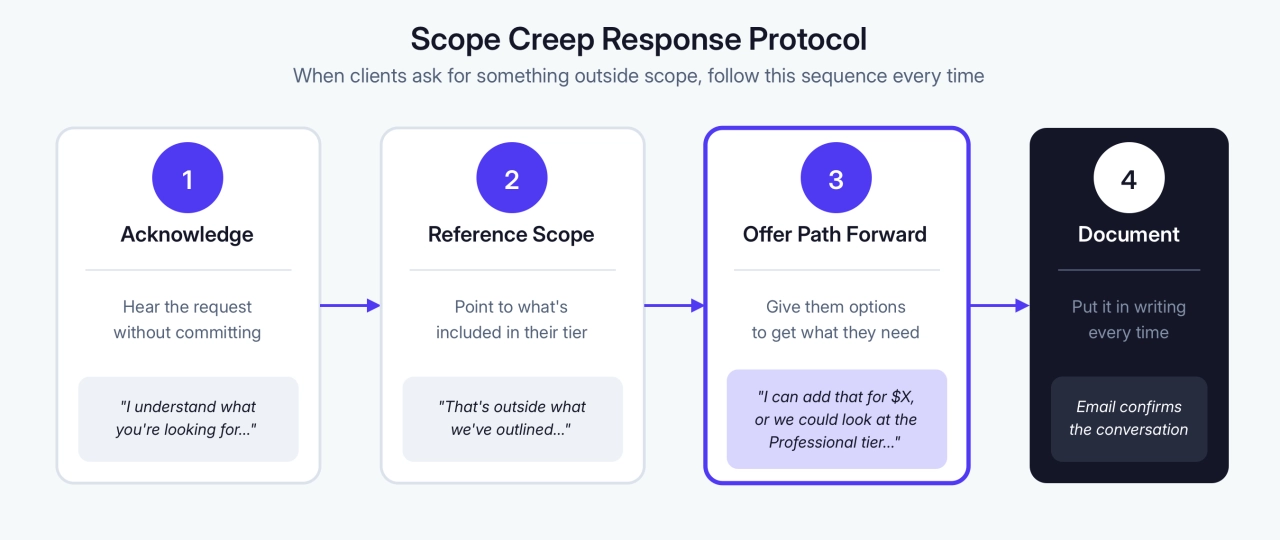
You’re not being difficult. You’re training clients—and yourself—to operate within the new model.
Communication templates that work
The way you communicate the transition matters as much as the transition itself. Here are templates you can adapt.
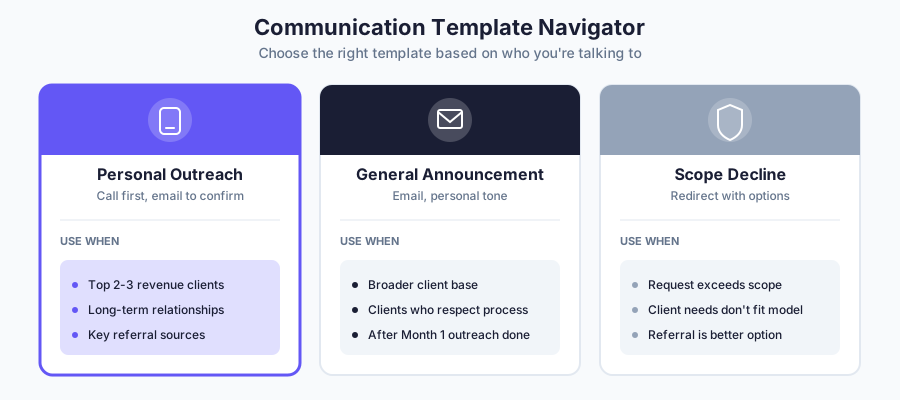
Personal outreach to top clients
Use this for your highest-value clients during Month 1. Call first, then follow up with an email that confirms what you discussed.
Subject: Quick update on how we’re working together
Hi [Name],
Following up on our call—thanks for taking the time to chat.
As I mentioned, we’re evolving how we deliver [service] to give you more predictable results and clearer expectations on both sides. Here’s what that means for you:
What stays the same: [list 2-3 things they care about]
What’s changing: [specific changes, framed as benefits]
Timeline: These changes take effect [date]. Until then, nothing changes on your end.
Because you’ve been with us for [X time], I want to make sure this works for you. If you’d prefer [option: grandfathered rate / extended timeline / premium tier], let me know and we’ll set that up.
I’ll check in again in a few weeks to see how things are going. In the meantime, reply to this email or call me directly if you have questions.
[Your name]
General announcement to all clients
Use this for Months 2-3 when you’re rolling out to everyone. Keep it shorter than you think it needs to be.
Subject: Changes to how we work together (effective [date])
Hi [Name],
We’re making some changes to how we deliver [service], starting [date].
The short version: We’re moving to a clearer package structure that makes it easier to know exactly what you’re getting and when. Most clients won’t need to do anything—your current plan maps to [tier name].
What you’ll notice:
[Change 1, framed as benefit]
[Change 2, framed as benefit]
[Change 3, framed as benefit]
If you have questions: Reply to this email and I’ll get back to you within [timeframe].
Thanks for being a client. We’re making these changes because we want to serve you better, and I think you’ll see the difference.
[Your name]
Handling “your needs exceed our scope”
This is the hardest conversation. A client wants something you’re no longer offering, and you need to decline without damaging the relationship.
Hi [Name],
Thanks for reaching out about [request].
I want to be upfront: what you’re describing falls outside what we’re set up to deliver well in our current model. I could try to squeeze it in, but I don’t think you’d get our best work—and you deserve better than that.
Here’s what I can offer:
Option 1: We can handle [modified version of request] as part of your [tier] package. That would look like [specifics].
Option 2: I can connect you with [referral partner name], who specializes in exactly this kind of work. I’ve worked with them before and trust them to take care of you.
Let me know which direction feels right, or if you want to talk it through.
[Your name]
Done well, this conversation builds trust. You’re being honest about what you can deliver—and giving them a real path forward.
Frequently asked questions
What if my best client refuses to transition?
Grandfather their arrangement for 6–12 months while you build revenue elsewhere. Some will come around once they see the model working. Others won't—and that's information worth having.
How much notice should I give before changes take effect?
Minimum 30 days for standard clients, 60–90 days for your top accounts. The 6-month timeline in this guide gives you room to have conversations, address concerns, and let clients adjust their own planning. Rushing it saves you a few weeks but costs you relationships.
Should I grandfather pricing for existing clients?
For small increases (10–20%), grandfather for 6 months as a loyalty gesture. For larger jumps, consider a stepped increase—smaller bump now, full pricing at renewal. Make it feel fair, not free.
How do I handle clients who keep asking for exceptions?
Document everything in writing: "That falls outside our package. I can add it for $X, or we can discuss upgrading." If they keep pushing without paying, it's a compatibility problem.
What if I lose too many clients during the transition?
Some churn is normal. If you're losing significantly more than expected, survey the clients who left—either your packages miss the mark, communication was unclear, or pricing is off. If most clients can’t make the transition work, revisit whether your service is right for productization in the first place.
When should I refer a client instead of transitioning them?
When their needs genuinely don’t fit any tier you offer, and forcing the fit would hurt both of you. A good referral preserves the relationship and often comes back as a referral to you later. A bad forced fit ends in frustration and a negative review.
What if a client is mid-project when I transition?
Review them before announcing anything. Your current agreements may have renewal terms, rate lock provisions, or notice periods that affect your timeline. If a contract guarantees rates through a certain date, honor it—or negotiate an early termination that works for both sides. Springing changes on clients who have written agreements is a fast way to damage trust and invite legal headaches.
Make the transition count
Transitioning existing clients to a productized model is harder than starting fresh. But it's also more valuable—you're not abandoning years of relationships, you're evolving them.
The 8 challenges most agencies face during productization? Most of them happen during the transition. Handle this phase well, and the rest gets easier.
Six months from now, you'll have a business that runs on systems instead of exceptions. The transition is the hard part. What comes after is why you started.