We talked to Bradley Benner from Semantic Links about 15 years in local SEO, why he thinks most link building is a waste of money, and how saying yes to something he’d refused for years became his biggest revenue stream.
When agencies ask Bradley Benner about the DA or DR of his links, he asks them a question back: “Why is that so important to you?”
Most can’t answer. And that’s his point.
Bradley runs Semantic Links, a white label link building service with 28 full-time team members. He doesn’t track DA. He doesn’t track DR. He uses metrics most SEOs have never heard of—and his agency now generates more revenue than his coaching company and retail SEO business combined.
Saying yes after years of no
For years, students in Bradley’s Semantic Mastery coaching community asked him to do the work for them. For years, he said no.
“I would always turn that down. I run my own local SEO agency. I don’t have the capacity to do work for others.”
In January 2022, he finally tested his relevance-based method with a few students at cost—no profit margin, just validation. The results matched what he’d seen with his own clients.
“I said, man, I’m onto something. There’s a gap in the marketplace for links with this type of relevance.”
He launched Semantic Links. Three months later, he signed up for SPP.co to productize the services. Revenue started climbing.
“I can’t believe I waited so long to start a white label services agency. The white label agency is my biggest revenue generator. It far exceeds my local SEO agency and my coaching company.”
A weird anomaly in Google Ads
Bradley had been running his own local SEO agency since 2010, working with tree service contractors. He outsourced link building to white label vendors. And like most agencies, he noticed the results getting worse.
“Around 2019–2020, I noticed that the links I had been purchasing from my vendors were not performing like they had been. I kept having to spend more of my client’s retainer on additional links to achieve the same results.”
But it was his Google Ads campaigns that revealed what was actually happening. Exact match keywords—the ones in square brackets that should only match that specific phrase—were suddenly showing impressions for completely different queries.
“Tree service would show for tree service, arborist service, tree removal service, tree trimming service, tree care service. All these different keywords that before you would have to separate out into single keyword ad groups.”
Bradley spent eight months testing different link types and vendors. He figured out what had changed: Google wasn’t evaluating keywords anymore. It was evaluating entities.
An entity is a person, place, or thing. And Google has in its database all of the search queries associated with that entity. Instead of optimizing for search queries, if we optimize for entities, it’s much more efficient for Google’s algorithm.
 Bradley Benner,
Semantic Links
Bradley Benner,
Semantic Links
That realization changed his on-page work. But it also made him question the entire premise of how SEOs buy links.
The metrics nobody tracks
“I get on sales calls with agencies, and they ask me, ‘What is the DA or DR of your links?’” Bradley says. “I tell them I don’t even know because I don’t track those metrics.”
When they push back, he asks why DA or DR matters to them. Most can’t answer.
“I watch them struggle to come up with a good reason why they even asked that question. Honest to God, I very rarely ever hear a decent answer from anybody about why DA or DR is important to you.”
Bradley isn’t saying these metrics are worthless—they became industry standard for a reason. But he thinks SEOs have confused the proxy for the thing itself. DA and DR measure what third-party tools think about a site. What he wants to know is what Google thinks.
What Bradley tracks instead is relevance—specifically, three levels of it:
Referring page relevance: Google checks if the page containing the link has matching topical categories to the target page.
Referring domain relevance: Google evaluates the overall topical themes of the entire linking site.
Backlink profile relevance: Google looks at whether the links pointing to the referring domain are also topically relevant.
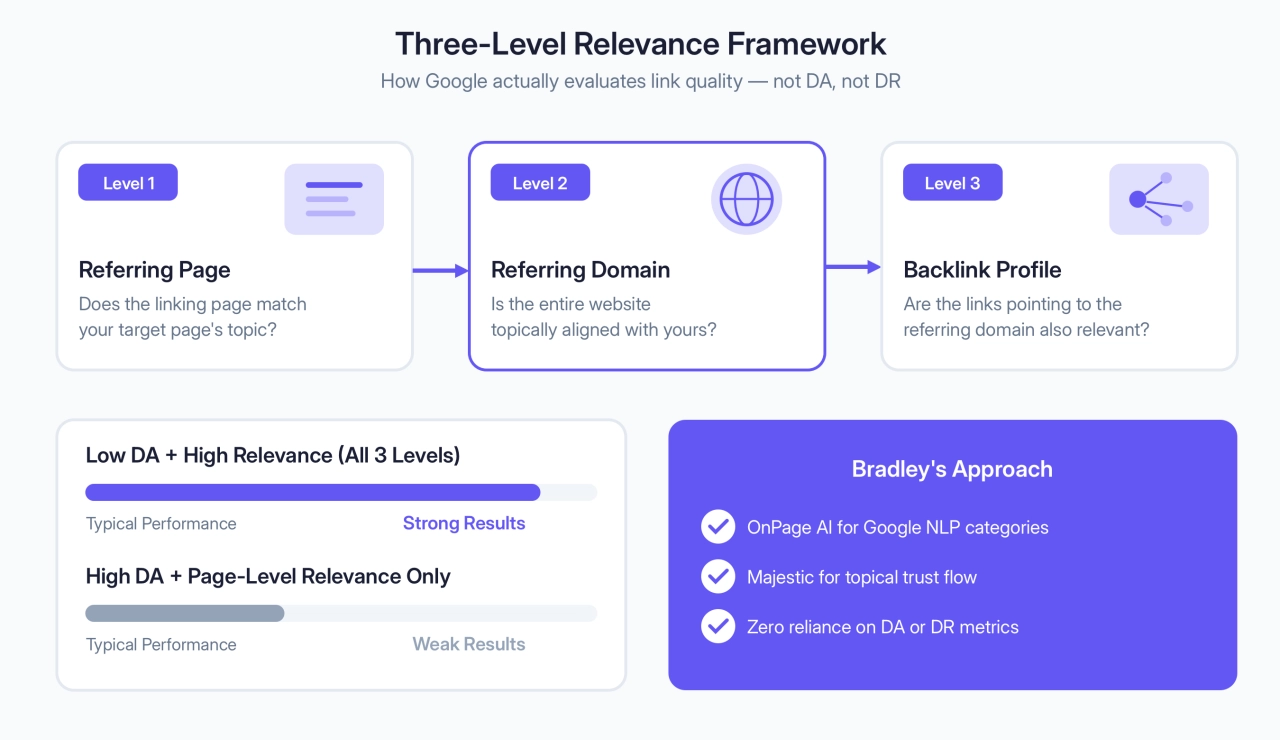
He uses OnPage AI because it integrates with Google’s Natural Language API—so he can see how Google categorizes a page’s content. And he uses Majestic, but not for trust flow scores. He uses it for topical trust flow categories, which classify the relevance of a site’s backlink profile.
I don’t care about Ahrefs. I don’t care about Moz. I don’t care about SEMrush. And honestly, Google doesn’t care about Majestic either. Those are all metrics that we as SEOs use. But Google doesn’t care about any of them.
Bradley Benner,
Semantic Links
A low DA link with relevance at all three levels typically outperforms a high DA link that’s only relevant at the page level. And that’s how most link sellers operate—they sell based on DA, DR, and traffic, with relevance as an afterthought.
The report that sells itself
Bradley doesn’t pitch on sales calls. He shows data.
Every prospect gets a complimentary competitive link analysis. His team geolocates the browser to simulate local search, pulls the top five ranking competitor pages for the target query, and analyzes every backlink pointing to those pages.
They classify each anchor text into five categories. They calculate averages across all competitors. They identify which topical categories Google associates with pages that are actually ranking.
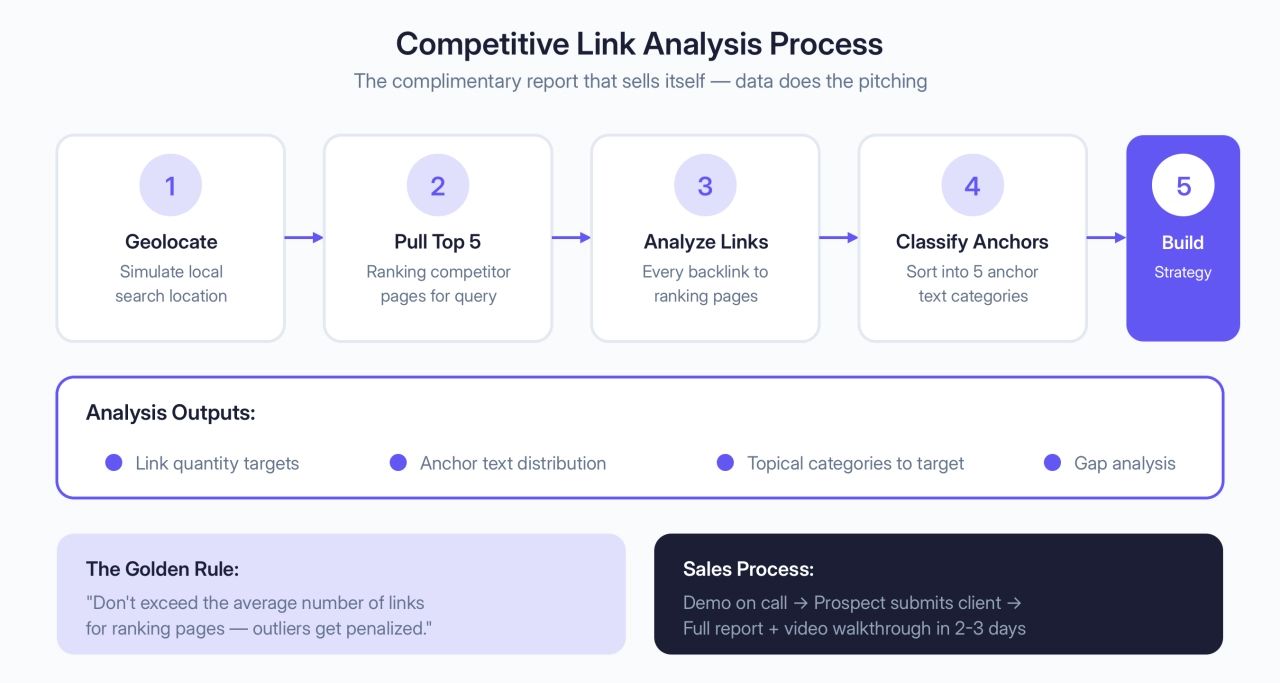
“This tells us the quantity we can build and which anchor texts we should use. […] We try not to exceed the average number of links for ranking pages. In SEO, you don’t want to be an outlier—if you stick your head above the crowd, Google’s going to come kick your face in.”
About 80% of prospects don’t submit their own client for analysis before the call, so Bradley demonstrates with one of his tree service clients. Then he extends the offer: submit a client afterward, and his team will prepare the full report with a video walkthrough within two to three days.
By the follow-up call, the data has usually done the selling for him.
What the results look like
Bradley’s retail agency, TreeCare HQ, gives him a testing ground for his methods before rolling them out to white label clients.
One example: Sequoia Tree and Crane Service in Beverly, Massachusetts. When Bradley started with them a couple of years ago, they had barely any presence in their own market—despite being a well-established company with a certified arborist on staff. Now they dominate a large area of Essex County.
A more recent case: Box Tree Care in Leander, Texas, a suburb of Austin. The owner, Josh Box, had been in Bradley’s nurture sequence for months after an initial call in early 2024. He wasn’t ready to buy. Bradley didn’t push.
“I don’t hard pitch or hard sell any of my clients. I just show them what we do. If it makes sense, great. If not, we’re going to be here whenever you’re ready.”
Box finally signed up in December 2024. Four months later, his Google Business Profile covers Leander and he’s expanding into Georgetown and Cedar Park.
“When you take a new business or a business that didn’t have a digital presence and in three to six months you get them dominating their local area—that’s very rewarding.”
Bradley’s examples are all tree service companies—that’s his niche. But the methodology isn’t industry-specific. Relevance is relevance. A plumber needs links from sites Google associates with plumbing, not generic high-DA blogs.
No more custom proposals
Before SPP.co, Bradley’s services weren’t productized. Every project was custom. He’d been running his retail agency that way for years—custom proposals for every client, hours spent on pitches that never closed.
“In my coaching community, most members come in with that model. They pitch a local business client, and it’s a custom proposal for every single one. Sometimes you spend hours on a proposal that never gets accepted.”
That was Bradley’s life for years. Every prospect meant a new scope, a new price, a new document. Most said no. The time was gone either way.
He set up subscription tiers—$299, $499, $749 per month based on competition level. No custom proposals. Checkout pages ready to go.
The speed with which we can go from a sales call to a closed deal is a hell of a lot shorter now. And for prospects who don’t close on the call, we plug them into a predefined nurture sequence for that specific service.
Bradley Benner,
Semantic Links
He applied the same approach to his retail agency, TreeCare HQ. Faster sales cycles, no wasted proposal time.
“It made all the difference. Even my own local SEO agency now, I’m able to scale it so much easier. No custom proposals ever.”
The shift wasn’t just operational. It changed how Bradley thought about his time. A no used to cost him hours. Now a no costs him a 30-minute call.
No contracts, three-month ask
Semantic Links doesn’t use contracts.
“If we’re doing our job, they should want to continue using our services. If we’re not getting results, they should be free to leave. And if a client turns out to be a pain in my ass, I don’t want to be stuck with them either.”
Instead, Bradley asks for a three-month commitment—not contractually, just as an understanding. He explains that Google is slow at indexing now. Links placed today won’t register for two to three weeks.
“When we send the third month report, you’re really only looking at the first two months of link building.”
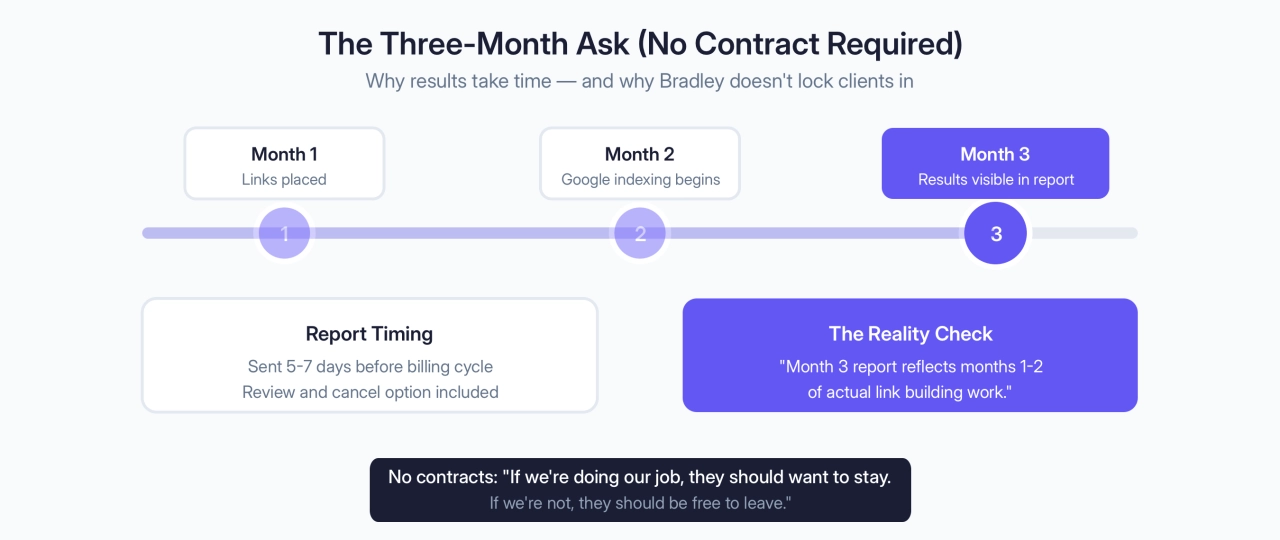
Reports go out five to seven days before the next billing cycle. Clients can review and cancel before they’re charged again. By month three, most see enough improvement to stay.
“I only recommend the bare minimum I think will show performance gains. If it eats up all the profit margin for the agency, what’s the incentive for them to send that client to me? […] We get the subscription for longer. Win, win, win.”
There’s another reason retention is easier with agency clients. His tree service contractors—as much as he likes them—aren’t exactly tech-savvy.
“A lot of those tree guys have an aversion to online marketing. A lot of them still work off of a notepad and paper calendars. I swear to God they do. So when I’m talking with them, it’s never about SEO. It’s always about results, because they don’t understand it and don’t want to.”
Agency clients get it. “I get to talk in SEO speak, technical jargon. I don’t have to dumb it down.” They see the reports, understand the methodology, and stay longer because they know what they’re paying for.
Transparency as the product
One thing Bradley disliked about the white label vendors he used to buy from: he couldn’t see what they were actually doing.
“The reports were very vague. Pay no attention to the man behind the curtain. I hated that.”
So he built Semantic Links around full transparency. In SPP.co, each client gets an embedded Excel file showing every campaign his team is managing for that agency. The client portal links to:
the competitive link analysis workbook
white-labeled Bright Local reports (rank tracking, local search grids, citations)
the ClickUp card for that project, showing real-time progress
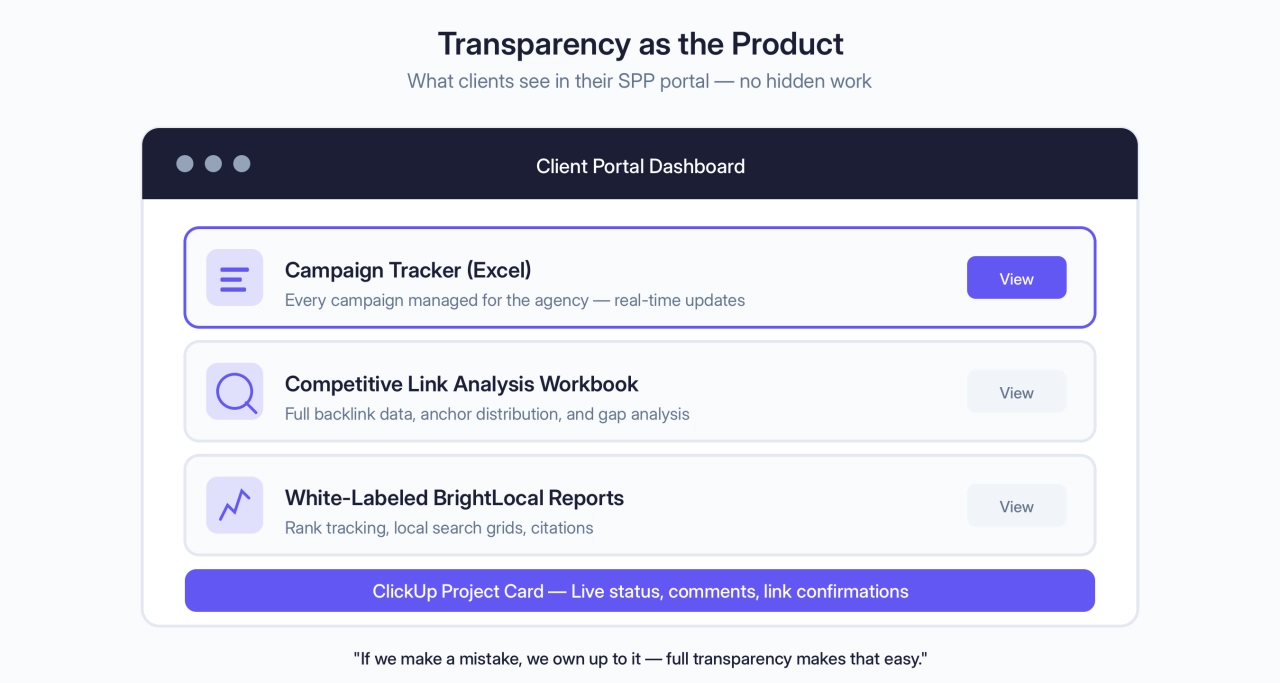
“We share all project data through our client portal so they can see in real time exactly what we’re doing. My project manager comments in the links after confirming they’re live. Clients see what stage the campaign is in, what’s outstanding, everything.”
Transparency also makes mistakes easier to handle.
“My team makes mistakes. We’re human. Because we’re fully transparent, if we make a mistake, we own up to it. We don’t try to cover it up. We correct it immediately.”
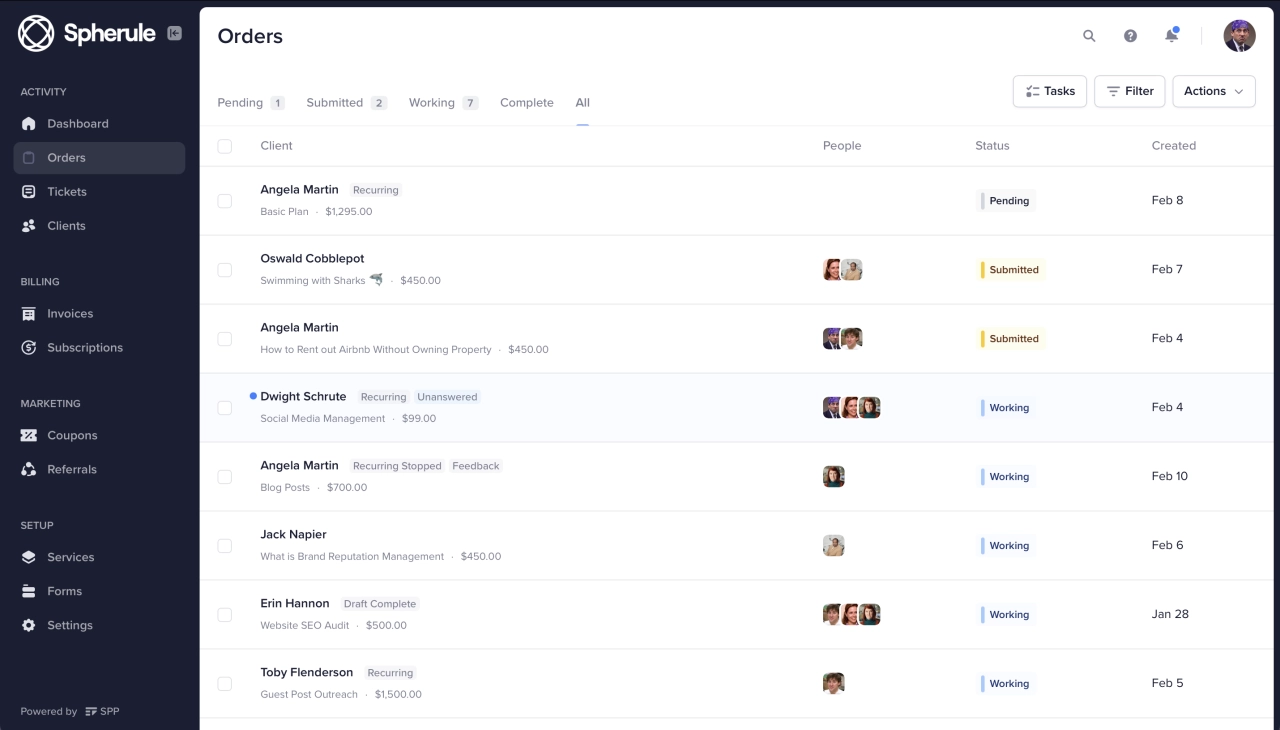
SPP’s order threads keep communication centralized. Bradley’s team instructs clients to message within the order thread so everyone has access to the history.
“Otherwise you get a separate support ticket or a separate email and the whole team doesn’t have access. SPP.co made it easy to keep all communication for an order in one thread.”
Closing thoughts
Bradley spent years turning down the opportunity that became his biggest business. When coaching students kept asking him to do the work, he kept saying no. When he finally tested it, the results were obvious.
The relevance methodology, the productized services, the transparent reporting—none of it is complicated. But it required questioning metrics the industry had accepted as default.
For agencies wondering whether their link building spend is actually working, Bradley offers a free competitive link analysis. He’ll pull the backlinks pointing to the top five competitors in your client’s market and show you what they have in common—and what your client’s profile is missing.
Visit semanticlinks.io to learn more about Bradley’s approach. For free local SEO Q&A, check out Semantic Mastery’s YouTube channel—over 4,000 videos from their weekly Hump Day Hangouts.